Brand Aspirations Amid Economic Precarity: Consumption Desires among Low-Income Women in Urban Bangladesh
Keywords:
Branded consumption, aspiration, low-income women, respectability, urban Bangladesh, social comparison, media influenceAbstract
Background
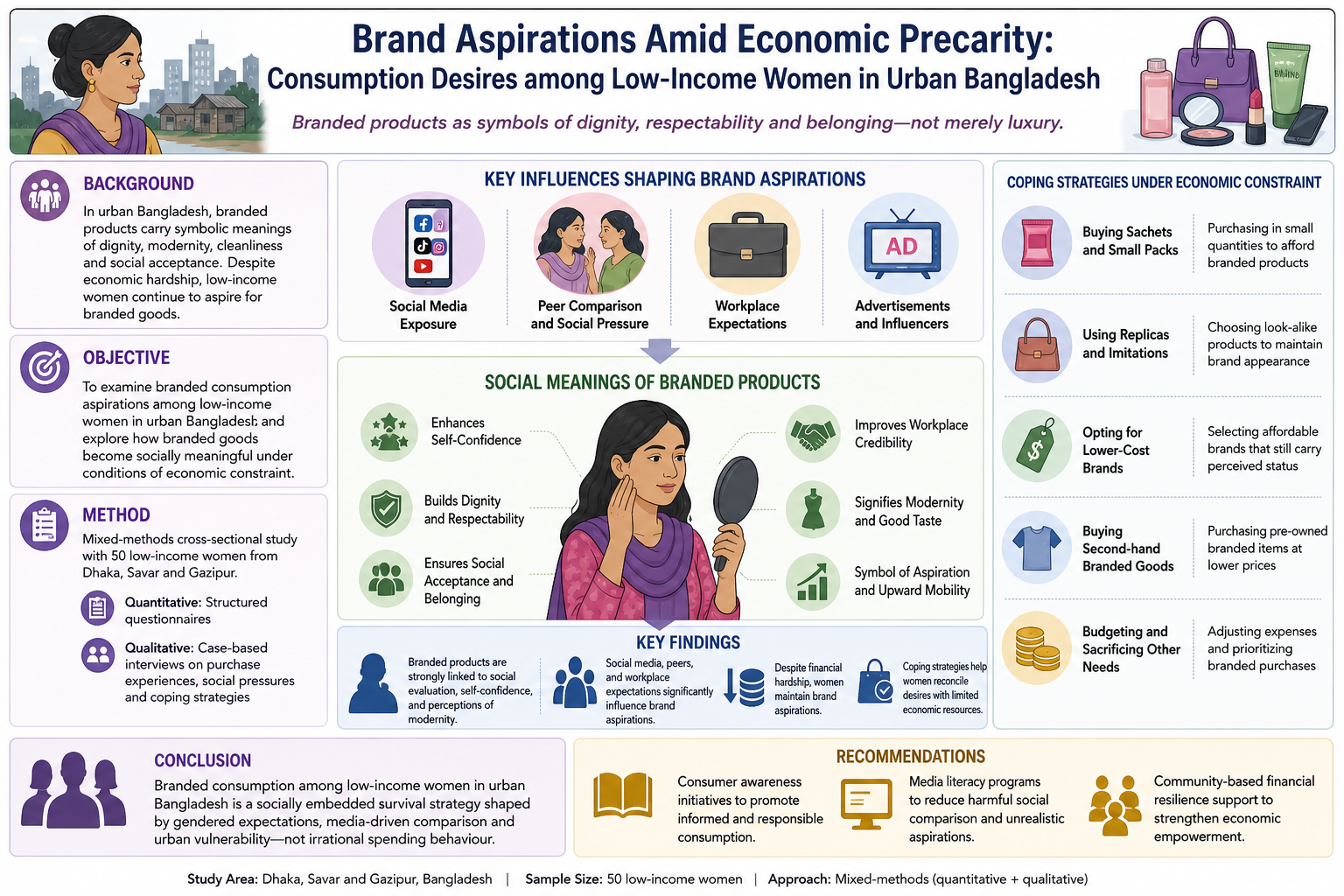
Branded consumption among low-income women in urban Bangladesh is often misunderstood as luxury-seeking or materialistic behavior. However, branded products may carry deeper social meanings related to dignity, respectability, cleanliness, and social belonging.
Objective
This study examines branded consumption aspirations among low-income women in urban Bangladesh and explores how branded goods become socially meaningful under conditions of economic constraint.
Method
A mixed-methods cross-sectional study was conducted among 50 low-income women living in Dhaka, Savar, and Gazipur. Quantitative data were collected through structured questionnaires, while qualitative insights were gathered through case-based interviews on purchase experiences, social pressures, and coping strategies.
Results
Findings show that branded products are strongly linked to social evaluation, self-confidence, workplace credibility, and perceptions of modernity. Social media exposure, peer comparison, and workplace expectations influenced participants’ brand aspirations. Despite financial hardship, women maintained these aspirations through strategies such as buying sachets, replicas, second-hand branded goods, and lower-cost brands.
Conclusion
Branded consumption among low-income women should be understood as a socially embedded survival strategy shaped by gendered expectations, media-driven comparison, and urban vulnerability, rather than irrational spending behavior. The study recommends consumer awareness initiatives, media literacy programs, and community-based financial resilience support.
References
[1].Appadurai, A. (2004). The capacity to aspire: Culture and the terms of recognition. In V. Rao & M. Walton (Eds.), Culture and public action (pp. 59–84). Stanford University Press.
[2].Atik, D. (2011). Conspicuous consumption of the poor in a developing country: A qualitative study. Advances in Consumer Research, 39, 728–729.
[3].Bangladesh Bureau of Statistics. (2023). Household income and expenditure survey (HIES) 2022: Key findings. Statistics and Informatics Division, Ministry of Planning, Government of Bangladesh.
[4].Bourdieu, P. (1984). Distinction: A social critique of the judgement of taste (R. Nice, Trans.). Harvard University Press.
[5].Creswell, J. W., & Creswell, J. D. (2018). Research design: Qualitative, quantitative, and mixed methods approaches (5th ed.). SAGE Publications.
[6]. DataReportal. (2025). Digital 2025: Bangladesh. Kepios.
[7].Festinger, L. (1954). A theory of social comparison processes. Human Relations, 7(2), 117–140. https://doi.org/10.1177/001872675400700202
[8].Goffman, E. (1959). The presentation of self in everyday life. Anchor Books.
[9].McRobbie, A. (2004). Post-feminism and popular culture. Feminist Media Studies, 4(3), 255–264. https://doi.org/10.1080/1468077042000309937
[10].Nobi, N., Rahman, S., Ali, M., Obayda, A., Shohel, A., & Tani, T. (2023). Impact of social media advertising on buying decision of young group of consumers in Bangladesh: A study in Dhaka city. Estudios de Economía Aplicada, 41(2). https://doi.org/10.25115/sae.v41i2.9105
[11].Paulhus, D. L. (1991). Measurement and control of response bias. In J. P. Robinson, P. R. Shaver, & L. S. Wrightsman (Eds.), Measures of personality and social psychological attitudes (pp. 17–59). Academic Press.
[12].Shipman, A. (2004). Lauding the leisure class: Symbolic content and conspicuous consumption. Review of Social Economy, 62(3), 277–289. https://doi.org/10.1080/0034676042000253909
[13].Skeggs, B. (1997). Formations of class and gender: Becoming respectable. SAGE Publications.
[14].Tourangeau, R., & Yan, T. (2007). Sensitive questions in surveys. Psychological Bulletin, 133(5), 859–883. https://doi.org/10.1037/0033-2909.133.5.859
[15].Veblen, T. (2009). The theory of the leisure class. Oxford University Press. (Original work published .
Downloads
Published
Data Availability Statement
The data that support the findings of this study are available from the corresponding author upon reasonable request. To protect participants’ privacy and confidentiality, the dataset is not publicly shared.
Issue
Section
License
Copyright (c) 2026 Arjun, Priyanka (Author)

This work is licensed under a Creative Commons Attribution 4.0 International License.
All articles published in the Asian Journal of Arts and Social Sciences (AJASS) are open access and licensed under the Creative Commons Attribution 4.0 International License (CC BY 4.0), unless otherwise stated. Authors retain copyright of their work and grant AJASS the right to publish the article as the official version of record. Readers may read, download, share, copy, distribute, and reuse articles in any format, provided proper credit is given to the author(s), article title, journal name, and original source. Any reuse, adaptation, or translation must clearly indicate if changes were made.