Exploring the Relationship between Mobile Phone Use, Academic Performance, and Mental Health among Adolescents
Keywords:
Mobile phone use, Adolescents, Academic performance, Mental health, Depression, Digital well-being, BangladeshAbstract
Background
Mobile phone use has become an important part of adolescents’ daily lives, especially for communication, education, entertainment, and social interaction. However, excessive and uncontrolled use of mobile phones may create negative consequences for young people, particularly in relation to academic performance and mental well-being. In Bangladesh, adolescents are increasingly exposed to mobile phones at an early age, making this issue an important area of social and public health concern.
Objective
This study examined the association between mobile phone use, academic performance, and mental health among adolescents in Bangladesh.
Methods
A cross-sectional quantitative study was conducted among 165 adolescents from Dhaka, Rangpur, and Savar to examine the relationship between mobile phone use, academic performance, and mental health. Data were collected through a structured questionnaire containing questions on socio-demographic characteristics, patterns of mobile phone use, study habits, academic outcomes, and selected mental health-related indicators. The respondents were selected from the study areas using a suitable sampling approach. After data collection, the responses were checked, coded, and entered for analysis. Descriptive statistics, including frequency and percentage distributions, were used to summarize the characteristics of the respondents. Chi-square tests were applied to examine the association between mobile phone use and key study variables, including academic performance and mental health status. A significance level of 5% was considered for statistical interpretation.
Results
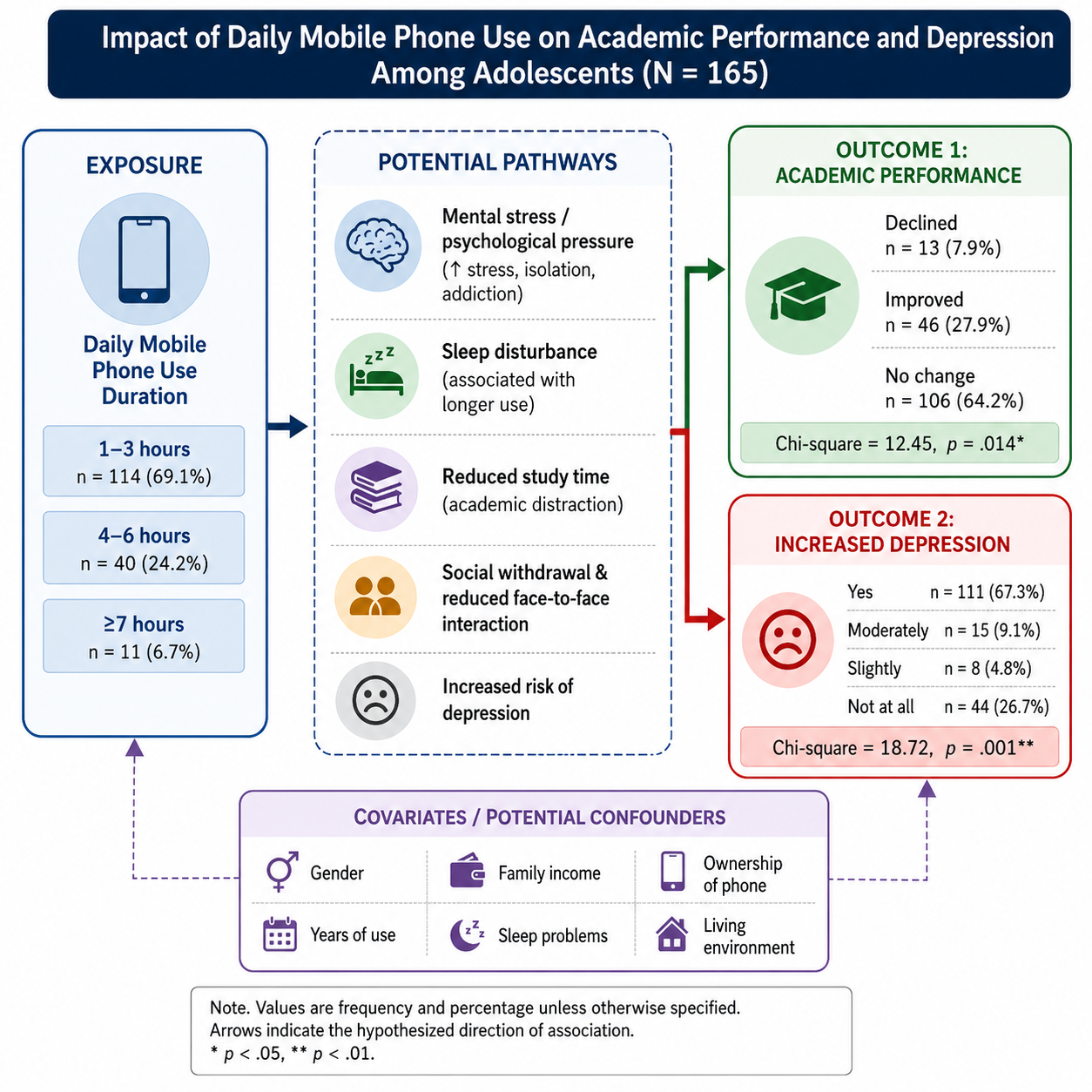
The findings show that mobile phone use was highly common among the respondents, and 75.2% of the adolescents had their own mobile phone. Daily mobile phone use was significantly associated with academic performance (χ² = 12.45, p = .014), indicating that patterns of phone use may influence students’ educational outcomes. The study also found a significant association between daily mobile phone use and increased depression (χ² = 18.72, p = .001). In addition, many respondents reported mental pressure, social isolation, addictive behavior, sleep disturbance, and other health-related concerns linked to excessive mobile phone use.
Conclusion
The study concludes that excessive mobile phone use may negatively affect both academic performance and mental health among adolescents. These findings highlight the need for parental guidance, school-based awareness programs, and responsible digital habits. Promoting balanced mobile phone use may help adolescents benefit from digital technology while reducing its harmful effects on their education and psychological well-being.
References
[1]. Elhai, J. D., Dvorak, R. D., Levine, J. C., & Hall, B. J. (2017). Problematic smartphone use: A conceptual overview and systematic review of relations with anxiety and depression psychopathology. Journal of Affective Disorders, 207, 251–259. https://doi.org/10.1016/j.jad.2016.08.030
[2]. Kuss, D. J., & Griffiths, M. D. (2017). Social networking sites and addiction: Ten lessons learned. International Journal of Environmental Research and Public Health, 14(3), 311. https://doi.org/10.3390/ijerph14030311
[3]. Lepp, A., Barkley, J. E., & Karpinski, A. C. (2015). The relationship between cell phone use and academic performance in a sample of U.S. college students. SAGE Open, 5(1), 1–9. https://doi.org/10.1177/2158244015573169
[4]. Twenge, J. M., & Campbell, W. K. (2018). Associations between screen time and lower psychological well-being among children and adolescents: Evidence from a population-based study. Preventive Medicine Reports, 12, 271–283. https://doi.org/10.1016/j.pmedr.2018.10.003
Downloads
Published
Data Availability Statement
The data that support the findings of this study are available from the corresponding author upon reasonable request. To protect participants’ privacy and confidentiality, the dataset is not publicly shared.
Issue
Section
License
Copyright (c) 2026 Tanvir Hasan Rafi Rafi, Nusrat Jahan Mim Mim, Md. Ariful Islam Ariful (Author)

This work is licensed under a Creative Commons Attribution 4.0 International License.
All articles published in the Asian Journal of Arts and Social Sciences (AJASS) are open access and licensed under the Creative Commons Attribution 4.0 International License (CC BY 4.0), unless otherwise stated. Authors retain copyright of their work and grant AJASS the right to publish the article as the official version of record. Readers may read, download, share, copy, distribute, and reuse articles in any format, provided proper credit is given to the author(s), article title, journal name, and original source. Any reuse, adaptation, or translation must clearly indicate if changes were made.