Education, Livelihood, and Income Inequalities among the Khumi Indigenous Community in Bangladesh
Keywords:
Khumi community, Indigenous livelihoods, income inequality, education, Chittagong Hill TractsAbstract
Background
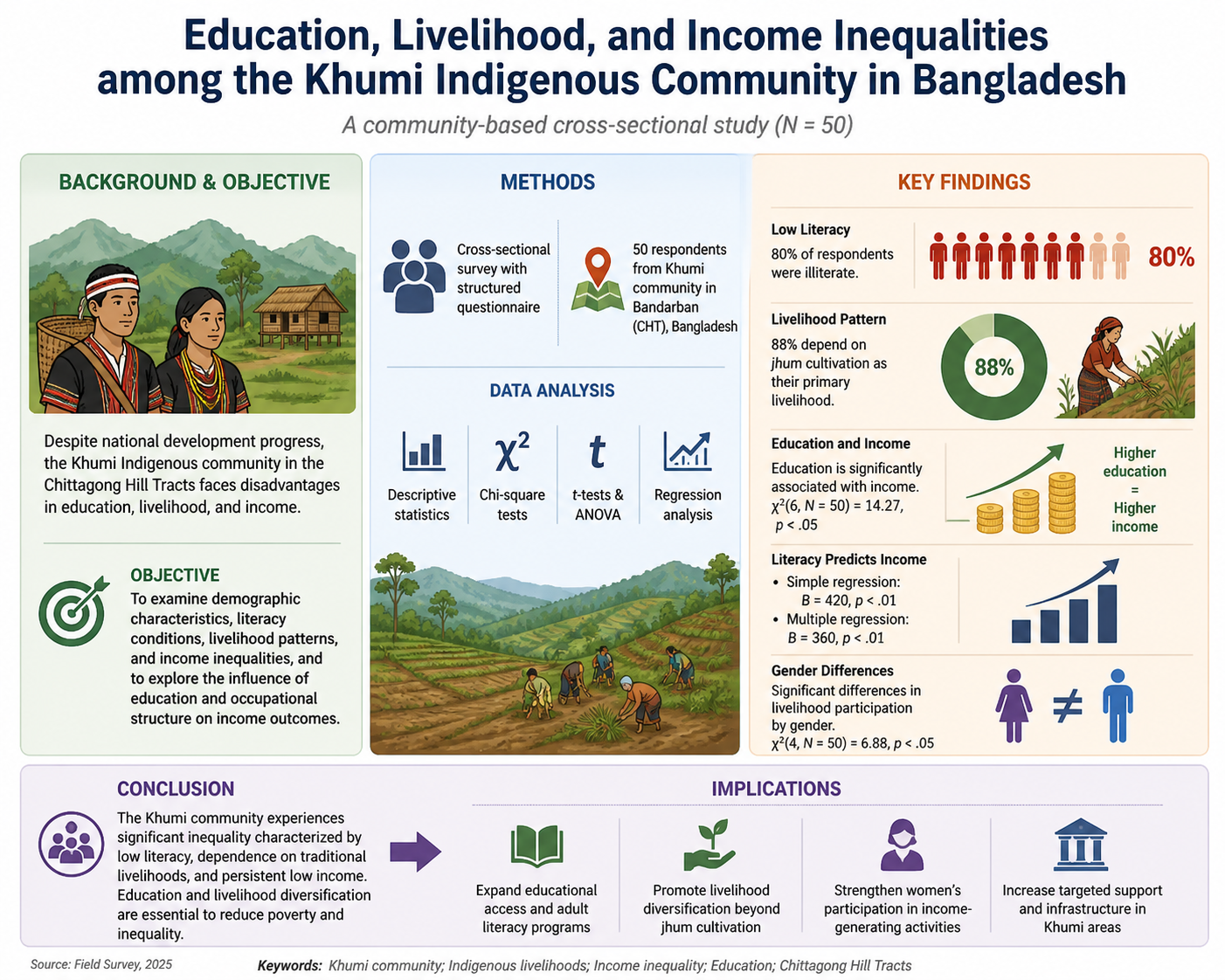
Despite national development progress in Bangladesh, Indigenous communities living in the Chittagong Hill Tracts (CHT) continue to experience substantial socioeconomic marginalization. Among smaller Indigenous populations such as the Khumi community, limited educational access, dependence on traditional livelihoods, and economic insecurity remain major concerns. However, empirical studies examining the relationship between education, livelihood structure, and income inequality among the Khumi people remain limited.
Objective
This study aimed to examine demographic characteristics, literacy conditions, livelihood patterns, and income inequalities among the Khumi Indigenous community in Bangladesh and to explore how education and occupational structure influence income outcomes.
Methods
A community-based cross-sectional survey was conducted among 50 respondents from the Khumi community using a structured questionnaire. Descriptive statistics, chi-square tests, independent-samples t-tests, one-way ANOVA, and regression analyses were used to examine relationships between education, livelihood patterns, gender, and income.
Results
The findings revealed that 80% of respondents were illiterate and 88% depended on jhum cultivation as their primary livelihood. Education showed a statistically significant association with income, χ²(6, N = 50) = 14.27, p < .05. Regression analysis demonstrated that literacy significantly predicted higher income in both simple regression (B = 420, p < .01) and multiple regression models (B = 360, p < .01). Gender differences were significant in livelihood participation patterns, χ²(4, N = 50) = 6.88, p < .05.
Conclusion
The Khumi community experiences significant socioeconomic inequality characterized by low literacy, dependence on traditional livelihoods, and persistent low-income conditions. Expanding educational opportunities and promoting livelihood diversification may help reduce poverty and inequality among Indigenous communities in the Chittagong Hill Tracts.
References
[1]. Barkat, A., Poddar, A., Badiuzzaman, M., & Osman, A. (2008). Socioeconomic baseline survey of Chittagong Hill Tracts (CHT): Situation analysis report. Human Development Research Centre.
[2]. Holman, D., Salway, S., Bell, A., Beach, B., Adebajo, A., Ali, N., & Butt, J. (2021). Can intersectionality help with understanding and tackling health inequalities? Perspectives of professional stakeholders. Health Research Policy and Systems, 19(1), 97. https://doi.org/10.1186/s12961-021-00742-w
[3]. Sultana, M. T. (2024). A review of the lifestyle issues of the Khumi community. International Journal of Social Science and Human Research, 7(2), 1194–1202. https://doi.org/10.47191/ijsshr/v7-i02-39
[4]. Barkat, A., Poddar, A., Badiuzzaman, M., & Osman, A. (2008). Socioeconomic baseline survey of Chittagong Hill Tracts (CHT): Situation analysis report. Human Development Research Centre.
[5]. Holman, D., Salway, S., Bell, A., Beach, B., Adebajo, A., Ali, N., & Butt, J. (2021). Can intersectionality help with understanding and tackling health inequalities? Perspectives of professional stakeholders. Health Research Policy and Systems, 19(1), 97. https://doi.org/10.1186/s12961-021-00742-w
[6]. Sultana, M. T. (2024). A review of the lifestyle issues of the Khumi community. International Journal of Social Science and Human Research, 7(2), 1194–1202. https://doi.org/10.47191/ijsshr/v7-i02-39
Downloads
Published
Issue
Section
License
Copyright (c) 2026 Rafiul Karim Rafiu, Mst. Jannatul Ferdous Jannatul, Sayed Mahmud Hossain Sayed (Author)

This work is licensed under a Creative Commons Attribution 4.0 International License.
All articles published in the Asian Journal of Arts and Social Sciences (AJASS) are open access and licensed under the Creative Commons Attribution 4.0 International License (CC BY 4.0), unless otherwise stated. Authors retain copyright of their work and grant AJASS the right to publish the article as the official version of record. Readers may read, download, share, copy, distribute, and reuse articles in any format, provided proper credit is given to the author(s), article title, journal name, and original source. Any reuse, adaptation, or translation must clearly indicate if changes were made.